
Over the years, I’ve often wondered about something.
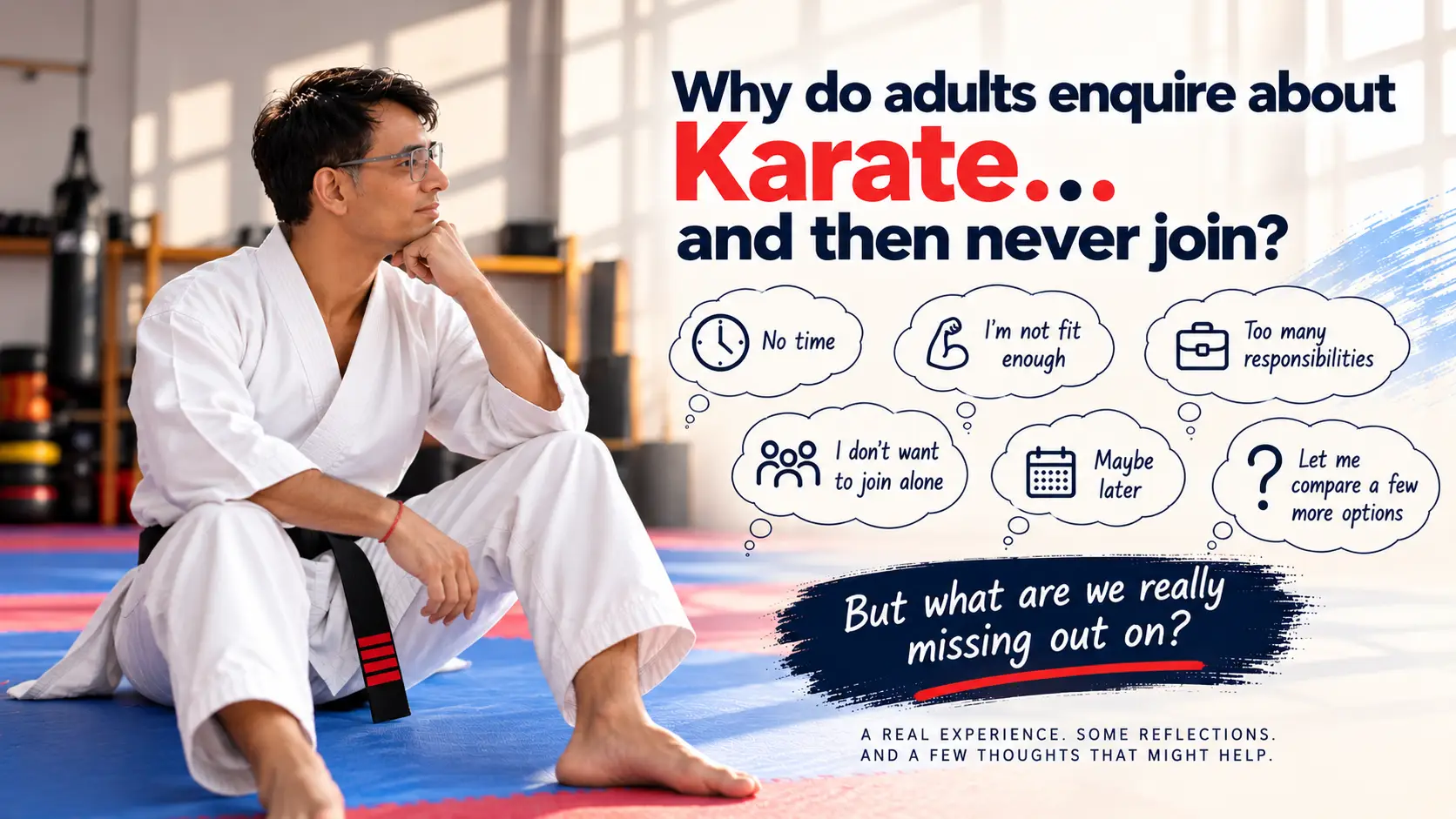
Why do so many adults enquire about learning Karate, show genuine interest, discuss the timings and fees, and sometimes even ask several questions about the training only to never show up?
It’s something I’ve experienced often enough to start looking beyond the obvious explanations.
Perhaps it’s the timing. Perhaps it’s the fee. Perhaps life genuinely gets in the way.
But what if there’s more to it?
I tried to make it easier to start.
When I started exploring ways to make Karate accessible to adults, I understood that their schedules would be different from those of children.
Adults have jobs, businesses, families, responsibilities, and commitments. Finding time for something new isn’t always easy.
So I tried to accommodate that.
I was willing to make myself available for early-morning classes, even at 5 AM. I considered late-evening sessions on weekends. I explored different training schedules to give people options that could work around their lives.
I didn’t expect everyone to train every day. I knew that wasn’t practical for most adults.
The idea was to make training possible, even with just a couple of focused sessions a week.
Then there was another concern I wanted to address: the discomfort of starting alone.
Imagine walking into a martial arts class as an adult, knowing nothing about the training, surrounded by unfamiliar movements and people who might already have experience. For someone who has never done it before, that can be intimidating.
So, when eight adults expressed interest in joining, I created a group for them. The idea was that they could begin together, encourage one another, and feel more comfortable taking that first step.
Eight people. One group. An opportunity to start together.
Nobody turned up.
I won’t pretend that wasn’t disappointing.
I’d made time, thought about the arrangements, and tried to remove some of the barriers that might prevent people from beginning. Yet the group never got started.
It made me think about how often we try to solve practical problems when the real hesitation might be somewhere else.
What actually holds us back?
I don’t believe there’s one answer. Everyone has their own circumstances, and an enquiry doesn’t necessarily mean someone is ready to commit.
But over time, I’ve noticed some common patterns.
We compare Karate with the gym. We wonder whether two classes a week are enough. We worry about our age, our fitness, or whether we’ll be able to learn at all.
We want to know what results we’ll get, how quickly we’ll get them, and whether the time and money will be worth it.
Some people explore several options, hoping to find the perfect one. Others wait for work to become less demanding or for life to settle down.
And some simply keep telling themselves, “Maybe later.”
Of course, these concerns aren’t unreasonable. Adults should make informed decisions about how they spend their time and money.
But there’s a difference between making an informed decision and trying to eliminate every uncertainty before starting.
Sometimes, we want to know what the experience will be like before we’re willing to experience it.
And that isn’t always possible.
Then I see something interesting.
Some parents enrol their children in Karate and watch them train for months. They see the classes, the routines, the challenges, and the gradual improvement.
Eventually, a few of them decide to join themselves.
They come in as beginners. They don’t necessarily have a background in martial arts or a high level of fitness. They have their own limitations, responsibilities, and apprehensions.
But they start.
And that contrast has stayed with me.
Some adults spend a long time considering whether they should begin. Others take that step after seeing the experience up close.
It makes me wonder whether familiarity plays a role. Perhaps watching someone learn makes the process seem less intimidating. Perhaps seeing a supportive training environment helps people realise they don’t have to be perfect before they start.
Whatever the reason, it reminds me that being a beginner is not something to be embarrassed about.
It’s simply where learning begins.
Karate isn’t just another workout.
One of the things that can get lost when we compare activities is that we’re not always comparing the same things.
A gym can be excellent for strength, conditioning, and fitness. Karate also develops physical abilities, but the training goes beyond exercise.
You learn movement, coordination, technique, timing, awareness, and control. You repeat things that don’t come naturally at first. You make mistakes, receive corrections, and gradually improve.
You learn to be patient with yourself.
And sometimes, progress isn’t immediately visible. You might not leave every class feeling stronger or more accomplished. Some sessions will feel difficult. Some movements will take longer to understand than you expected.
That’s part of learning a skill.
With consistent training, you may also notice changes in your concentration, confidence, discipline, and how you approach challenges outside the dojo.
These benefits aren’t guaranteed to appear on a particular schedule. They develop through practice, and everyone’s experience is different.
But they’re worth discovering for yourself.
You don’t need to train five or six days a week to begin. Two focused classes a week, regular practice, and patience can be a reasonable starting point.
You don’t need to be fit before joining. You can work on your fitness as you train.
You don’t need to be young. Adults can begin learning at different stages of life, adapting the training to their individual abilities and circumstances.
And you don’t need to know anything about Karate.
You come to class to learn. You don’t have to arrive already knowing how.
What I’ve come to realise as an instructor
I can create the opportunity. I can work on the timings, provide guidance, make beginners feel welcome, and help people find a way to fit training into their lives.
I can explain what Karate involves and what they might gain from it.
But I cannot make the decision for them.
And I don’t think that should be my role.
People have different priorities. Some may genuinely not have the time or resources right now. Others may decide that Karate isn’t for them. That’s perfectly fine.
An enquiry doesn’t create an obligation to join.
At the same time, I think it’s worth asking ourselves whether we’re saying no because something genuinely doesn’t work for us, or because we’re uncertain about trying something unfamiliar.
There’s a difference.
One is a decision based on our circumstances. The other might be a decision made without ever finding out what the experience could offer.
Recognising that difference can be useful, whether we’re considering Karate, learning an instrument, returning to a sport, or starting anything we’ve been putting off.
Perhaps the answer is to try before deciding.
If you’ve been considering adult Karate classes, you don’t need to make a lifelong commitment today.
You don’t need to imagine yourself as a black belt or decide how far you’ll go.
Start with the first class. Understand what the training involves. Give yourself time to become familiar with the movements and the environment.
If you can, train consistently for a few months. Allow yourself to be a beginner. Notice what changes, what you enjoy, what challenges you, and whether the experience fits your life.
Then make an informed decision based on what you’ve experienced, rather than what you’ve imagined.
You may discover that Karate isn’t for you. That’s a perfectly valid outcome.
Or you may discover that you’ve found something you want to continue — something that challenges you physically, engages your mind, and gives you a little time each week to focus on yourself.
You won’t know until you try.
And perhaps that’s the point I’ve been trying to understand all along.
As an instructor, I can keep creating opportunities for people to learn. I can make the first step more accessible.
But sometimes, the most important step is the one we have to take ourselves.
Don’t compare endlessly in your head. Try it. Give yourself a few months. Experience it for yourself.
You might discover something you didn’t know you were looking for.
